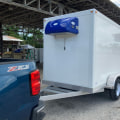
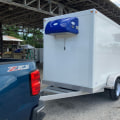
When considering the advantages and disadvantages of using a refrigerated trailer or a dry van for your cargo, it's important to find the right fit. For those in need of an Ice Trailer Rental near West Ashley SC, it's worth noting that refrigerated trucks typically carry between 42,000 and 44,000 pounds, slightly less than dry vans due to the additional weight of refrigeration equipment and insulation. When considering the advantages and disadvantages of using a refrigerated trailer or a dry van, you don't consider which trailer is better than the other, but which one is more suitable for the type of cargo you are going to transport. For example, cases where the trailer axles are spaced 10 feet 2 apart from each axle can weigh 20,000 pounds on the scale, allowing the trailer axles to weigh a total of 40,000 pounds instead of 34,000 for closed tandem axles. When considering the advantages and disadvantages of using a refrigerated trailer or a dry van for your cargo, it's important to find the right fit. For those in need of an Ice Trailer Rental near West Ashley SC, it's worth noting that refrigerated trucks typically carry between 42,000 and 44,000 pounds, slightly less than dry vans due to the additional weight of refrigeration equipment and insulation. When considering the advantages and disadvantages of using a refrigerated trailer or a dry van, you don't consider which trailer is better than the other, but which one is more suitable for the type of cargo you are going to transport. For example, cases where the trailer axles are spaced 10 feet 2 apart from each axle can weigh 20,000 pounds on the scale, allowing the trailer axles to weigh a total of 40,000 pounds instead of 34,000 for closed tandem axles.
The maximum payload for intermodal shipments is strictly 42,500 pounds, and there are additional steps that the shipper must take into account when loading an intermodal container to protect against load changes that could make weight distribution illegal. Refrigerated trailers are designed to be as strong and lightweight as possible, so you can carry the maximum product in the cold chain without exceeding the federal GVWR (80,000 pounds for double axles or 90,000 pounds if you have a third axle).Consider the advantages and disadvantages of each of them when choosing the right type of trailer for you. The 53-foot trailer is the industry standard for long-distance transportation, offering maximum cargo space while remaining legal on highways in most states. Reefers have insulators, cooling units and ducted floors to control temperature, while dry vans are standard enclosed trailers with no air conditioning capacity. The reasons for the lower load weight are the thicker walls of the refrigerator covered with insulation and the included refrigeration unit, adding more weight to the trailer.
Refrigerated trailers are used for items that require a temperature-controlled environment and are at risk of being damaged or damaged if not kept at a specific temperature. No trailer is a one-size-fits-all solution, so when choosing the right trailer for your load, you must consider aspects such as the weight of the merchandise, the temperatures at which it must be stored and the most cost-effective solution for your company.